
Increase Retail Foot Traffic With Holiday Lighting
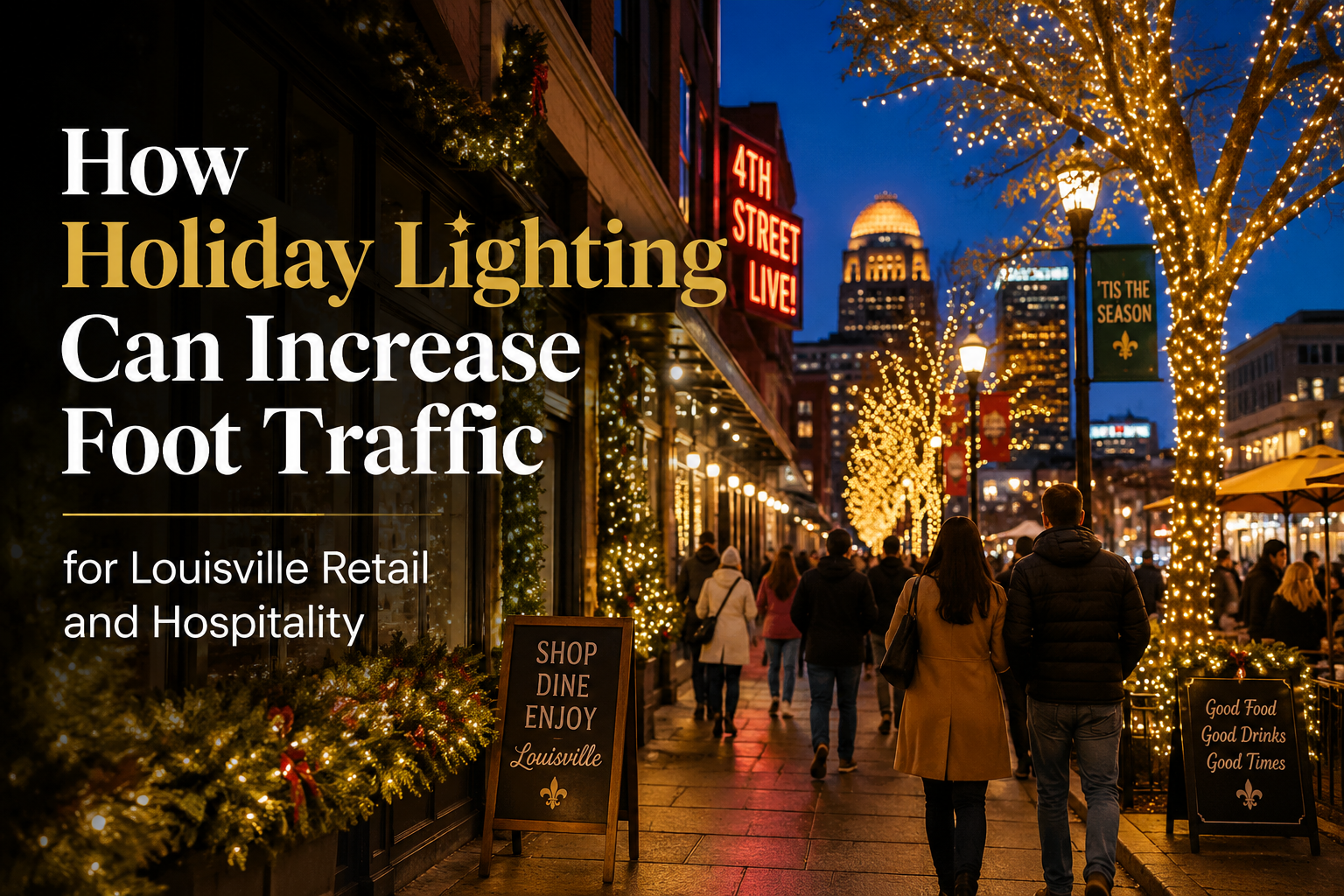
Holiday lighting increases foot traffic for retail stores, restaurants, and hospitality properties by creating a visual draw that pulls people in from the street and gives them a reason to stop, look, and enter. For Louisville business owners who want to make the most of the holiday season, a professional exterior display is one of the highest-visibility investments available. This guide covers what actually works, what does not, and how local businesses are using festive lighting to drive real customer behavior.
What You Will Learn
- Why exterior holiday lighting is a proven foot traffic driver, not just decoration
- What design elements actually pull people in versus just looking nice from a distance
- How Louisville retail centers, restaurants, and hotels are using lighting differently
- What the Boo at the Zoo experience tells us about lighting and crowd behavior
- How to plan a display that works for your specific property type and customer
People Walk Toward Light
This is not a marketing insight. It is how people work. On a dark December evening, a business with a warm, well-lit exterior pulls attention from the street in a way that an unlit storefront does not. People slow down. They look. And if the display is good enough, they stop.
The question is not whether holiday lighting affects customer behavior. It does. The question is what kind of lighting and what kind of design actually moves people from the sidewalk through the door, versus the kind that looks nice from a passing car and gets forgotten.
We have been doing large-scale commercial installations in Louisville through Hancock Landscape since 1996. And we light the Louisville Zoo every year for Boo at the Zoo. That event draws thousands of families specifically to walk through a lit environment. They are not coming for the animals in December. They are coming for the lights. That is a real-world example of how a well-executed lighting environment affects foot traffic at scale.
What Actually Drives People In
Not all holiday lighting works the same way. There is a real difference between a display that reads as intentional and one that reads as an afterthought. And customers feel that difference even when they cannot articulate it.
Entrance lighting is the most important zone
This is where the decision happens. A customer walking past your restaurant or retail store makes a subconscious judgment about whether to stop, largely based on how the entrance looks. A well-lit, warm, inviting entrance signals that someone put thought into the customer experience. A dark or generic entrance signals the opposite.
The most effective entrance displays do three things. They are visible from a distance, so they catch attention on approach. They have a focal point that gives the eye somewhere to land, usually a feature at the entrance. And they use warm color temperatures that read as welcoming rather than cold.
Window and facade lighting frame the space
For retail stores and restaurants with street-facing windows, lighting the facade draws the eye to the interior. Roofline outlines and window-frame lighting make the building itself a visual asset rather than just a container for the business. It is the difference between a building that disappears into the streetscape at 6 pm and one that stands out.
This is especially relevant for Louisville retail centers where multiple tenants share a strip or center. A center with several lit tenants and one dark one makes the dark one look closed, even when it is not. Foot traffic follows the light.
Consistency across the property matters
A lot of displays put all the attention on the entrance. The problem is that's only one part of the property. Customers still have to park, walk to the building, and find the front door. If those areas are dark, the display feels unfinished. We like to spread the lighting across the property so it feels complete instead of stopping at the front sign.
This is the same principle behind commercial Christmas light installation design for hotels and hospitality properties, where guests experience the property at multiple distances, from the road, at the entrance, and inside the lobby, all in the same visit.
How Different Property Types Use This Differently
Retail centers and restaurants
For retail, the goal is dwell time and impulse stops. A customer who was walking to a destination and pauses in front of a well-lit storefront is already a potential conversion. Restaurants benefit from the same effect plus the added dimension of warmth. A restaurant with warm exterior lighting in December reads as the exact place you want to be on a cold night.
The specific elements that work best for retail and restaurant facades are roofline outlines, window-frame lighting, entrance arches or column garlands, and feature trees flanking the entrance. These are the elements that catch attention from the street and hold it long enough for someone to decide to go inside.
Hotels and hospitality
Hotels have a more layered challenge. The display needs to work for three different audiences simultaneously. Drive-by traffic that sees the property from the road. Arriving guests who experience the entrance up close. And guests who are already inside and see the property from the lobby or common areas.
For hotels, the investment in a strong arrival drive display pays back in guest satisfaction and social sharing. Guests who check in through a beautifully lit entrance in December are starting their stay differently than those who pull up to an unlit building. That first impression contributes to how they rate the stay and, increasingly, to how they photograph and share it.
The Boo at the Zoo example
One of the more interesting projects we've been part of was lighting the Louisville Zoo for Boo at the Zoo. Every night, families lined up to walk through the display. The lights were the attraction. They set the mood before anyone even reached the entrance.
Commercial properties aren't all that different. We've seen a restaurant feel busier after adding lighting to the front entrance. We've watched shopping centers become more noticeable from the road with nothing more than lit trees and a few wreaths. It doesn't take an over-the-top display. It takes a property that looks cared for. When a place stands out after dark, more people notice it. That's really what good holiday lighting is supposed to do.
What This Means for Your 2026 Display
If you manage a retail property, restaurant, hotel, or mixed-use center in Louisville or Lexington, the planning conversation for your 2026 holiday display should be happening now. Not because there is some manufactured urgency around Christmas in July. But because the properties that end up with displays that actually do this job well are the ones that planned them properly, instead of scrambling for a vendor in October.
We covered the full commercial planning timeline in the free how to plan your 2026 commercial display guide, which walks through budget ranges, design decisions by property zone, and vendor questions worth asking before you sign anything.
If you want to understand the booking timeline and why July is the right window, see our guide on booking before the fall rush. The short version is that prime September and October install dates are already committed by the time most people start calling.
Frequently Asked Questions
How much does commercial holiday lighting cost for a retail property?
Commercial pricing depends on property size, the number of lighting zones, the design scope, and the service level. We covered in detail what drives costs up or down in our commercial Christmas light installation guide. The honest answer is that we cannot quote without seeing the property. What we can tell you is that a well-executed display pays back in ways that are harder to quantify than the installation cost.
What is the difference between full-service and install-only for a commercial property?
Full-service covers design, installation, mid-season maintenance if anything goes out, takedown after the season, and storage for next year. Install-only means the vendor hangs the lights and leaves. For a commercial property where a dark display in mid-December is a real operational problem, full-service is almost always the right choice. See our guide on what a full-service installation includes for the full breakdown.
Do you handle large-scale or multi-building properties?
Yes. We light the Louisville Zoo every year for Boo at the Zoo, which is about as large-scale as commercial lighting gets in this market. Multi-building retail centers, hotel properties with multiple exterior zones, and mixed-use developments are all within scope. The crew size, equipment, and coordination required for larger properties are exactly what we built the Holiday Expressions operation around.
How early do I need to book to get a good installation date?
Earlier than most commercial clients expect. Prime September and October installation windows, which are the best dates for having a display up before peak retail season, start filling up in summer. If you are reading this in July, you are in the right window. After August, the calendar gets competitive fast, and design flexibility starts to shrink.
Do you serve properties outside of Louisville?
Yes. We serve Louisville and Lexington in Kentucky and Punta Gorda and Port Charlotte in Southwest Florida. Commercial clients across all four markets get the same full-service process and the same crew quality. If you manage properties in more than one of these markets, ask about multi-property pricing.
Ready to Plan a Display That Actually Works?
Holiday Expressions is a division of Hancock Landscape, co-founded by Todd and Jackie Hancock in Louisville in 1996. Our holiday expressions services cover design, installation, mid-season maintenance, takedown, and storage for residential and commercial properties across Louisville, Lexington, Punta Gorda, and Port Charlotte.
Request a free commercial consultation at myholidayexpressions.com or call 502-417-8700. If you want to go deeper on commercial planning before that call, download the free how to plan your 2026 commercial display guide. It covers everything from budget ranges to vendor questions to the month-by-month planning timeline.
Request a Free Commercial Consultation Call 502-417-8700